When the Noticeboard Goes Up in Flames
A four-part framework for human-centred tech adoption
Early in my career as a science teacher, I planned a lesson to demonstrate fractional distillation—showing how crude oil is heated to separate into petrol, diesel and other fuels. It was meant to be a brilliant, engaging demonstration of modern chemical engineering.
Instead, a small slip in the setup caused a sudden flash flare. Within seconds, the classroom noticeboard was on fire.
Fortunately, no one was hurt, we didn't need the fire brigade (just a fire-extinguisher) and the kids got out safely. But as we stood out on the playing field waiting for the smoke to clear, the lesson was unforgettably stark: it doesn't matter how fantastic or sophisticated everything looks on paper—if you haven't properly controlled the environment where the real work is going to happen, things can go up in smoke.
Many years later, guiding global organisations through massive software deployments, cloud migrations and AI integrations, I see enterprise leaders make the exact same mistake.
They invest millions in high-powered technology, assuming the sheer capability of the software will carry the day. But when go-live arrives, they haven't prepared the human environment. Adoption stalls, frustration rises and the rollout becomes an expensive corporate fire drill.
When a digital transformation fails, the instinct is to blame the software. But in my experience, rollouts rarely fail because of the code. They fail because leadership treats a human transition like a purely technical milestone.
Feel free to reach out for an initial consultation to discuss an upcoming project or Explore my full range of Organizational Change Management & L&D Services.
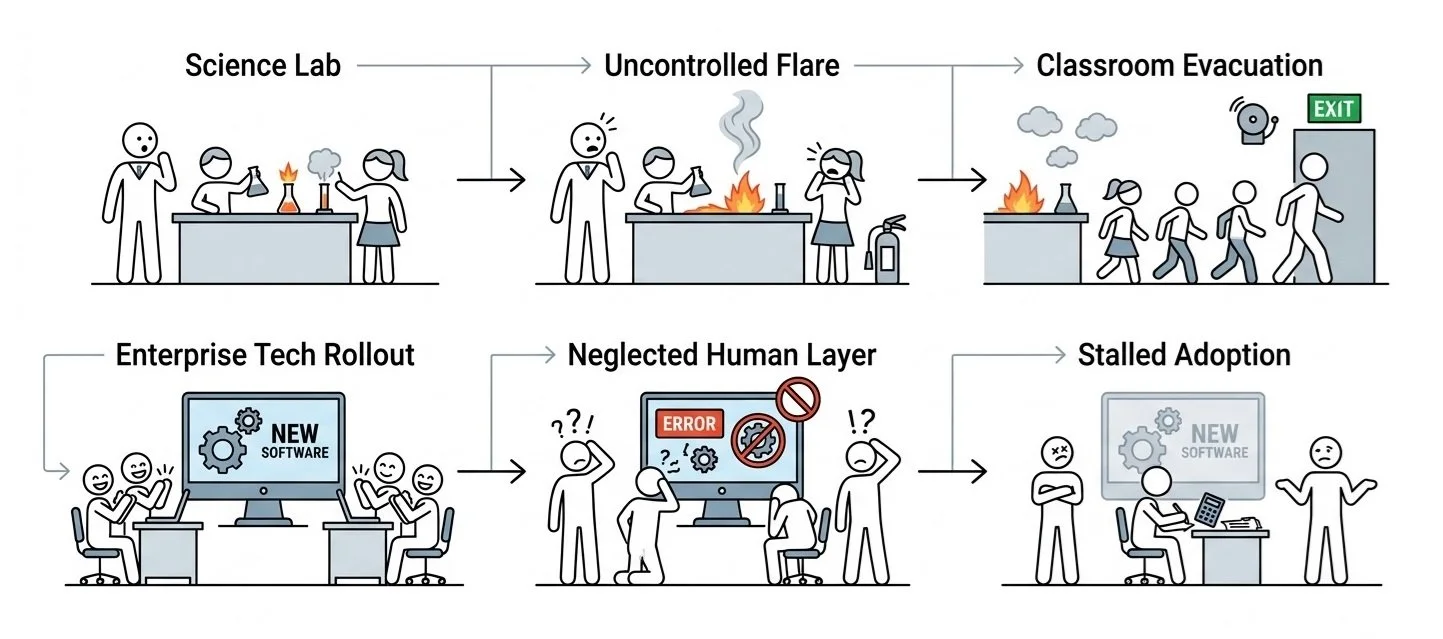
When leadership focuses only on the spark of new tech without preparing the room, things can go up in smoke.
Organisations don't adopt technology; people adopt habits. To bridge the gap between technical delivery and real-world capability, enterprise rollouts need a structured, human-centric approach to Organisational Change Management (OCM).
Here is the 4-part framework I use to align technology strategy with human adoption.
1. Strategic Alignment & Mapping the "Thermal Radius" (Stakeholder Impact Mapping)
Before anyone writes a training manual or schedules an all-hands call, you need to define what success actually looks like at the desk level—not just in the executive board deck.
Map the "Thermal Radius": Just like heat spreads unevenly across a room during a flare-up, enterprise change affects departments differently. Identify precisely which front-line roles will experience the highest friction in their daily routines. Focus 80% of your initial change effort on this high-impact radius rather than diluting effort across the entire company.
Unify the Leadership Narrative: If executives can’t explain why this shift is happening in two clear sentences—without resorting to jargon—your frontline managers won't be able to either. Leadership must speak with one consistent voice about the strategic why, not just the technical what.
📊 Success Metric: Alignment on the top 3 friction points across all department leads before configuration begins.
2. Targeted Communications: From Broadcast Emails to Conversation
Generic broadcast emails announcing go-live dates inevitably get buried in crowded inboxes. Effective change communication isn't about broadcasting information; it's about managing anxiety and building trust.
Move Beyond the Inbox: Replace long text announcements with short video walkthroughs, informal team huddles and drop-in Q&A sessions where people can raise real concerns.
Apply the "So What?" Test: "What’s In It For Me?" isn't a selfish question—it's human nature. Keep asking "so what?" on behalf of your audience until you reach a tangible benefit. If you can't explicitly explain how this new tool makes their daily routine easier or less frustrating, teams will treat it as an administrative burden.
📊 Success Metric: High engagement in two-way feedback channels (Q&A participation) rather than email open rates.
3. Experiential Learning: Practice Over PowerPoint
One-size-fits-all slide decks rarely build operational confidence. When go-live day arrives, people don't need theoretical knowledge; they need muscle memory.
Shift to Scenario-Based Sandboxes: Ditch static feature tours. Give teams hands-on sandbox environments where they can run realistic daily scenarios, make mistakes safely and build actual capability before live business data is on the line.
Mobilise "Change Champions": Identify respected peers and super-users within individual teams. On day one, peer-to-peer coaching at the next desk is infinitely more effective than waiting in a remote IT support queue.
📊 Success Metric: Competency and task-completion speed in simulated workflows prior to go-live.
4. Post-Launch Reinforcement: Go-Live Is the Deep End, Not the Finish Line
Cutting the ribbon on go-live isn't the end of a change initiative—it's the transition point where real adoption begins.
Track Friction, Not Just Logins: Logging in is a measure of compliance, not capability. Set up quick qualitative feedback loops to spot where workflows are clogging up so you can deploy targeted support immediately.
Protect Capacity & Celebrate Momentum: Acknowledge the temporary dip in speed that comes with learning a new skill. Publicly recognize teams adapting successfully to sustain operational momentum.
📊 Success Metric: Reduction in ticket error rates and time-to-proficiency over 30/60/90 days post-launch.
Building Capability for Your Next Transition
Whether you are heating crude oil in a science lab or deploying a new enterprise platform across a global business, success comes down to respect for the environment. When you protect and prepare the human layer, the technology finally gets the chance to do what it was designed to do.
💡 Preparing for a major system rollout or enterprise transition?
Whether you are launching new enterprise software or navigating complex organizational change, I help leadership teams align strategy with human capability.
💬 What’s your experience?
What is the biggest "classroom fire" moment you've witnessed during a corporate tech rollout? Join the conversation on LinkedIn here: [LINK].
