Churchill and the Art of Plain English

Photo by Nick Fewings on Unsplash
On 9 August 1940, with the Battle of Britain raging overhead, Winston Churchill sent a memorandum to the entire British Civil Service.
It wasn't about ammunition, aircraft production or troop movements. It was titled simply: "Brevity."
Churchill had grown exasperated by the mountain of official memos landing on his desk filled with woolly, passive phrases like "it is also of importance to bear in mind the following considerations" and "consideration should be given to the carrying out of."
His instruction was brutal and direct:
"Let us have an end to phrases like these. Most of these woolly phrases are mere padding, which can be left out altogether, or replaced by a single word. Aim at a concise style using short, crisp paragraphs."
War cabinet decisions and modern corporate updates sit at vastly different ends of the stakes spectrum, but the underlying friction is identical: unclear language slows down action. Churchill understood something that modern business leadership continually forgets: complex language isn't a sign of intelligence; it is a bottleneck to execution.
Yet eight decades later, enterprise communication is still smothered in posture. We sit in town halls playing corporate bingo (synergy, paradigm shift, operationalise, holistic) while strategy dies under a blanket of fluff.
Why We Hide Behind Big Words
Why do we do this? Why do intelligent professionals default to over-complicated language?
In most cases, corporate jargon is an emotional shield. It comes down to a deep-seated fear of looking inexperienced or unintelligent. We worry that if we write simply, people will think our ideas are basic. Complex vocabulary feels like proof of expertise, authority and status.
In reality, the opposite is usually true. Over-complicated language often masks a lack of true understanding. When you don't fully grasp a concept, it is easy to hide behind industry buzzwords. To explain something simply, however, you have to understand it inside out.
I love this quote from the Nobel Prize winning physicist Richard Feynman:
"If you can't explain it to a six-year-old, you don't understand it yourself."
When someone smothers a simple message in dense corporate code, they aren't demonstrating mastery. They are revealing that they haven't done the hard cognitive work required to make it clear.
Brevity Is Hard Work
Making the complex simple is my daily bread and butter. When writing technical training manuals or designing instructional frameworks for non-experts, my goal is always the same: strip away every single extraneous word while keeping the logic watertight.
Brevity can look easy on the finished page, but getting there can be an absolute pain, as the mathematician Blaise Pascal knew:
"I have made this letter longer than usual only because I have not had the time to make it shorter."
In practice, achieving that effortless clarity requires a delicate dance with Subject Matter Experts (SMEs).
When working alongside scientists, engineers or technical leads, I rely on them completely for domain accuracy. But SMEs naturally lean toward technical density—they want to include every caveat, edge case and historical detail.
The editing process becomes a constructive tug-of-war. We go back and forth across multiple drafts, negotiating line by line:
What is genuinely essential for an end-user to perform this task safely on Monday morning?
What is unnecessary fluff, background noise or occupational posture?
It takes patience, trust and shared commitment to iterate until everyone is happy—producing a manual that is technically accurate for the expert, yet instantly clear to the novice.
The Double-Edged Sword of AI
In recent years, Artificial Intelligence has become a powerful accelerator in this process—and a dangerous trap.
On one hand, AI is exceptional at helping you strip out clutter. You can drop a dense 1,000-word corporate update into an AI tool and ask it to extract the core actions, remove passive voice or rewrite it for a 12-year-old reading level. Used this way, AI acts as a sharp editing tool.
On the other hand, unguided AI will happily flood your writing with pomposity. Left to its own defaults, generative AI loves corporate fluff. Ask a standard tool to write a strategy update, and you get sentences like:
"This initiative stands as a testament to our commitment to spearhead holistic digital transformations across cross-functional matrix teams."
Direct that same AI to edit aggressively for brevity, and it becomes:
"We are updating our software to help teams share data faster."
AI can help you simplify, but only if you direct it to do so. If you aren't careful, it will merely automate the posture you are trying to eliminate.
When Jargon Is Actually Necessary
This entire process highlights a vital distinction in change management and instructional design: plain English is not about flattening every technical nuance into children's book language.
Having spent decades working across highly regulated industries like finance and pharmaceuticals, I know that certain terms are non-negotiable.
You cannot simply rename a Good Manufacturing Practice (GMP) deviation report or a regulatory audit trail because it sounds bureaucratic. In validated environments, those terms carry specific risk parameters, compliance obligations and legal definitions.
The danger is never technical precision; it is management posture.
You need precision when documenting a lab process or financial compliance protocol. You do not need corporate posturing when communicating a team strategy. The trouble starts when organisations use technical complexity as an excuse to cloak everyday communication in impenetrable woolly fluff—turning simple instructions into unreadable exercises in self-importance.
Why Plain English Wins
The human brain is an energy-conservation machine. It processes information through what cognitive scientists call processing fluency—the ease with which the brain receives, interprets and stores data.
When you write or speak in plain English, processing fluency is high. The brain grasps the concept immediately, evaluates it as trustworthy and acts on it.
When you clutter your message with buzzwords and passive prose, two destructive psychological effects take over:
Cognitive Overload (Sweller's Law)
Educational psychologist John Sweller demonstrated that human working memory has a strictly limited capacity. Dense, jargon-heavy text forces the brain to waste precious mental bandwidth translating your vocabulary into plain meaning beforeit can even begin to evaluate your idea. Working memory freezes and retention drops.
The Nominal Fallacy
Psychologists call this the mistaken belief that by giving something a new or complex name, you have explained, altered or solved it. When organisations decide to adopt new working styles, they often fail to change the underlying bureaucracy—they simply rename weekly catch-ups "scrums" and quick updates "huddles". Nothing changes except the vocabulary.
Some Practical Rules to Strip Out the Posture
To make your communication clearer, more authentic and far more effective, try applying these three rules to your next email, strategy document or town hall deck:
1. Write How You Speak Over Coffee
In corporate life, a strange inflation occurs the moment fingers hit the keyboard. Words we would never use in conversation suddenly fill the screen. We write "we are seeking to leverage cross-functional synergies" instead of "we need to work together."
This isn't about being overly casual or adopting slang; it is about restoring clarity of logic and natural cadence. Read your draft aloud. If a sentence feels stiff, pretentious or unnaturally formal when spoken to a colleague over coffee, rewrite it.
Replace "utilise" with use.
Replace "operationalise" with start.
Replace "optimise" with improve.
If it sounds like a human being saying it, it will land like a human being wrote it.
2. Kill the Passive Voice to Restore Ownership
Corporate writing relies heavily on the passive voice because it creates a safety buffer. It allows organisations to report outcomes without attributing human responsibility.
Passive: "It was determined that the deployment timeline would be adjusted." (By whom? Why? What failed?)
Active: "We delayed the launch by two weeks because our testing uncovered a bug."
Active sentence structures follow a simple, muscular order: Actor $\rightarrow$ Action $\rightarrow$ Impact. When you name who made the decision and state what they did, you strip away the protective fluff and replace it with genuine transparency and trust.
3. Apply the Monday Morning Test
Before sending a strategy memo or launching a change initiative, ask yourself one question: If an employee reads this, do they know exactly what they are doing differently on Monday morning?
If your draft is full of high-level abstractions like "driving cultural alignment" or "fostering agility," delete those paragraphs. Replace them with specific operational mechanics:
What meeting are we cancelling?
What form are we dropping?
What tool are we opening at 9:00 AM?
If you cannot translate your idea into a concrete action for Monday morning, you haven't finished the hard work of simplification yet.
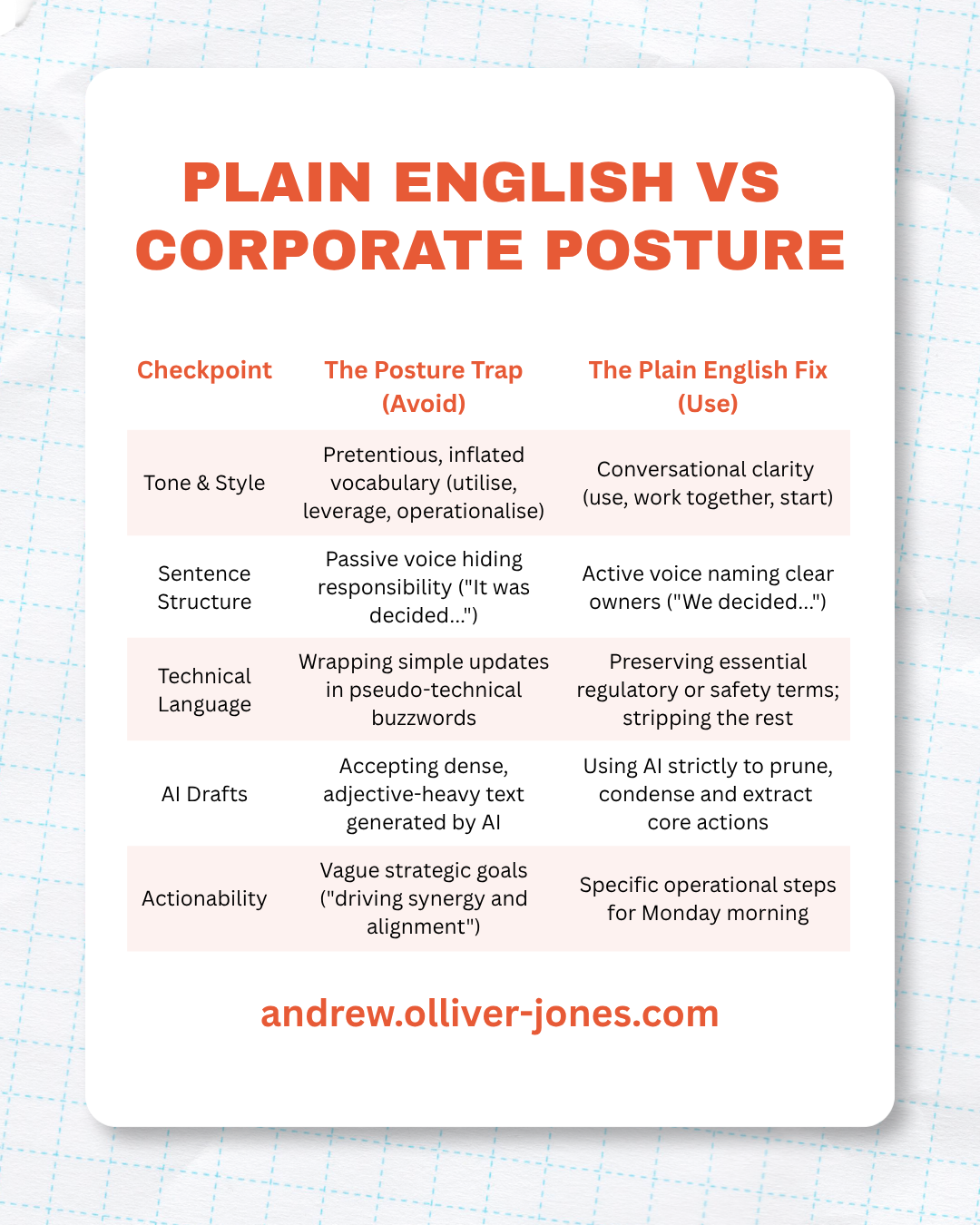
Plain English vs Corporate Posture
Bookmark or download this summary table to run a quick audit on your next key deliverable:
Need Help Making the Complex Simple in Your Organisation?
Pruning a single memo is relatively straightforward. Embedding this level of communication discipline across an entire change programme, global system rollout or technical training curriculum requires a systematic approach.
Stripping out corporate noise while preserving vital regulatory precision isn't just an editorial task—it is a strategic requirement for successful change, learning and organizational transformation.
If your team is struggling to communicate complex strategies, roll out major change initiatives or build technical training that employees actually understand and adopt, let's talk.
Take a look around the site to explore my case studies and approach, or Get in Touchto discuss how we can work together to bring clarity, adoption and momentum to your next project.
